Know the true quality of your software — before it becomes a business problem.
Prolifogy’s Scorecard Analysis is an independent software analysis of your architecture, code, and engineering decisions — delivered by senior engineers who also serve as expert witnesses. Results in as little as two weeks.
- Is this software built to last — reliable, secure, and scalable?
- What engineering risks exist before they become customer complaints or legal disputes?
- What should we fix first, and why does it matter to the business?
Trusted by engineering leaders, investors, and legal teams for independent software analysis.
One assessment, four business-critical outcomes.
A Scorecard Analysis is built around your objective — whether that’s a product release, an acquisition, a dispute, or simply peace of mind about code you inherited.
Independent & Objective
An outside engineering perspective, free of the incentives that shape internal reviews.
Beyond Surface-Level
We evaluate engineering decisions and their consequences — not just automated linting output.
Fast When It Matters
Accelerated timelines for M&A, litigation, or release deadlines — as short as two weeks.
A Report People Act On
Findings written for engineers, executives, investors, and attorneys alike.
What a Scorecard Analysis evaluates
Every engagement is customized to your objectives. A typical Scorecard Analysis examines:
How the analysis works
Every software system is different. We may evaluate a single application, an entire product suite, or a specific area of concern — the process scales to fit.
Scope the engagement
We collect information about your application and align on objectives, timeline, and which applications or code areas matter most.
Analyze the code
Consultants examine representative portions of the source code and supporting assets — architecture, practices, design consistency, and implementation quality.
Stay in the loop
We provide progress updates and remain available to discuss preliminary observations throughout.
Deliver the report
A written report with findings, significance, and recommendations — targeted to any audience you need, whether technical or business stakeholders, as brief or comprehensive as required, with source excerpts where useful.
Engineering judgment, not automated output.
Many firms offer code reviews. Some are little more than automated scans, catching surface-level issues while missing what actually determines software quality. Few offer the perspective that comes from evaluating software in environments where every engineering decision matters — including the courtroom.
Prolifogy’s consultants — some with Ph.D.s in computer science — combine decades of experience in software architecture, programming language design, compiler technology, and enterprise development. They also regularly serve as expert witnesses in software-related litigation, where software quality is examined under the highest possible scrutiny.
More about our teamBuilt around your timeline
No two software systems — or organizations — have identical needs. Built for enterprise-scale applications, we welcome projects of 250,000 lines of code or more, with no upper size limits. Some engagements support an impending release, acquisition, or active litigation, and move on an accelerated schedule. Others cover larger code bases or multiple applications and extend over several months for deeper analysis. Every Scorecard Analysis is planned around your objectives, timeline, and available resources.
The Deliverable
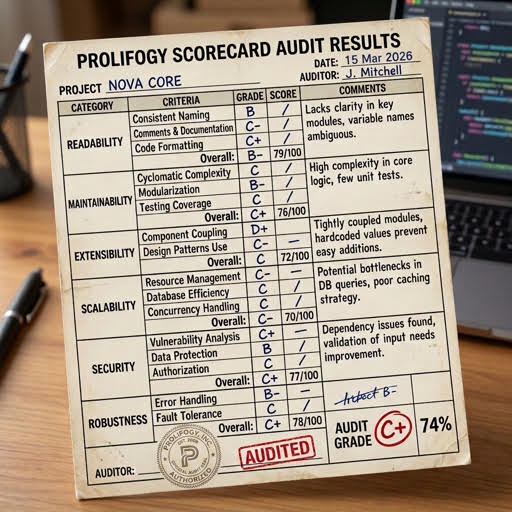
A comprehensive written report for technical and business audiences — findings, their significance, and practical recommendations. No hundred-page dumps of automated warnings, just meaningful engineering analysis backed by evidence.
Who Uses It
Engineering leaders, executives, investors, and attorneys use the report to understand the strengths, weaknesses, and long-term risks of a software system.
Often paired with a Scorecard Analysis
Depending on your objective, a Scorecard Analysis is sometimes the first step toward a more specialized engagement.
Source Code Analysis
A deep, line-level examination of a specific application or module.
Learn more about Source Code AnalysisSoftware Expert Witness
Testimony and technical analysis for software-related litigation.
Learn more about Software Expert WitnessPatent Advisory Services
Technical support for patent prosecution, licensing, and disputes.
Learn more about Patent Advisory ServicesReverse Engineering
Understanding undocumented or legacy source code and system behavior.
Learn more about Reverse EngineeringSubject Matter Expertise
Embedded technical expertise for teams tackling specialized problems.
Learn more about Subject Matter ExpertiseEnterprise Software Development
Custom-built systems designed for scale, security, and longevity.
Learn more about Enterprise Software DevelopmentCommon questions about the Scorecard Analysis
What’s the difference between a Scorecard Analysis and a typical code review?
A typical code review often relies on automated tools that flag surface-level issues. A Scorecard Analysis is a human-led engineering assessment that evaluates the decisions behind the code — architecture, scalability, security, and maintainability — and explains what those decisions mean for the business. See more on why this distinction matters.
How long does a Scorecard Analysis take?
Timelines vary with scope. Urgent engagements tied to litigation, M&A, or release deadlines can be completed in as little as two weeks. Larger, multi-application engagements may extend over several months.
Can a Scorecard Analysis evaluate AI-generated code?
Yes. AI-generated code carries the same — and sometimes greater — engineering risk as hand-written code, since correctness is never guaranteed simply because the code was machine-generated. Read more in AI Code Review Remains Insufficient.
Who typically requests a Scorecard Analysis?
Engineering leaders, executives, investors, acquirers, and attorneys who need an independent, defensible view of software quality. Common triggers include M&A due diligence, third-party code evaluation, and pre-release quality checks.

Get an independent read on your software.
Whether it’s technical due diligence, litigation support, or a quality check before your next release, the Prolifogy Scorecard Analysis gives you the engineering insight to decide with confidence.